
An interview with Lucile Hadžihalilović
by Oscar Bloomfield
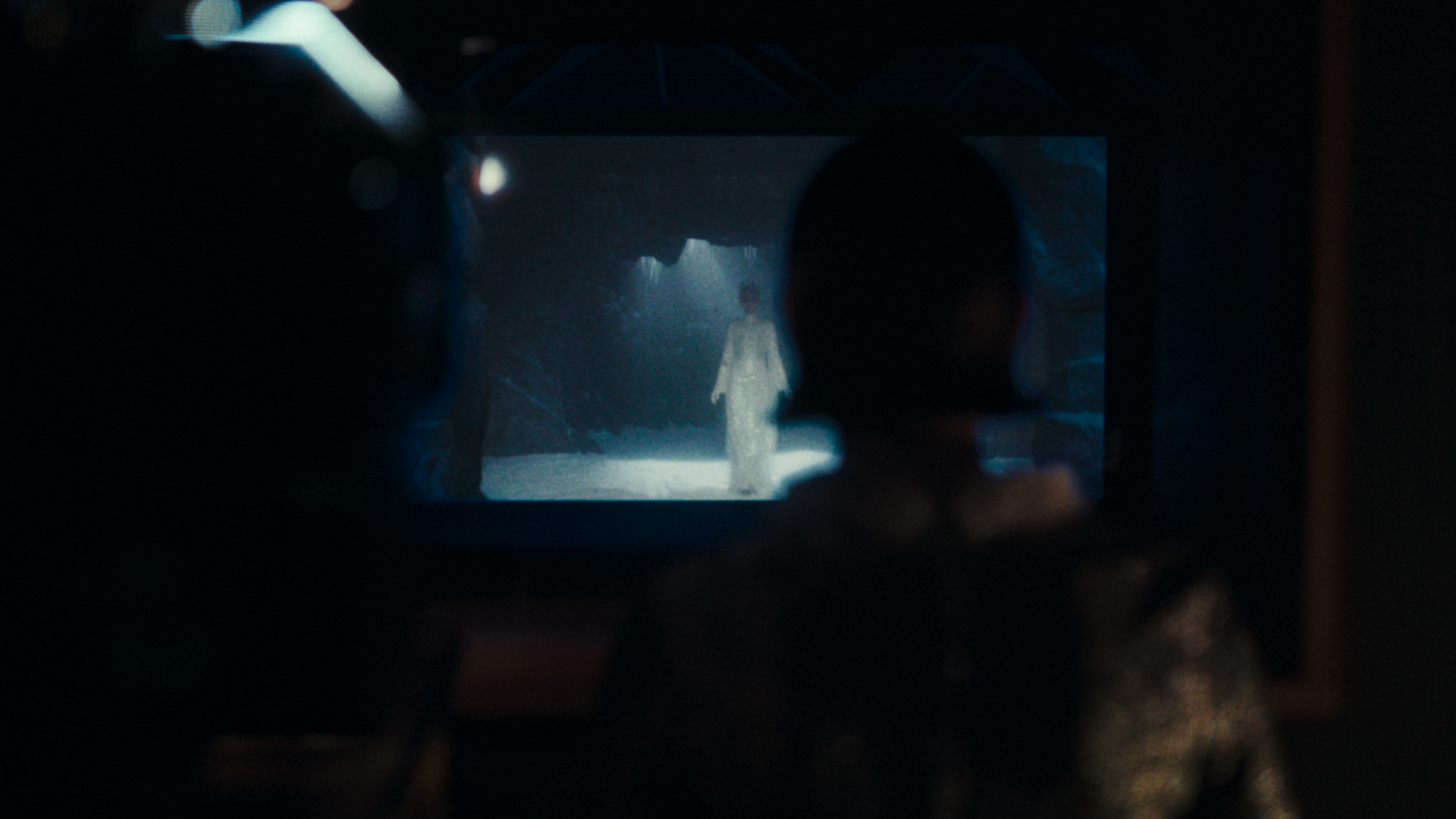
For French auteur Lucile Hadžihalilović, cinema is a playground of contradictions, a site wherein reality and fantasy intermingle. Across her oeuvre, Hadžihalilović has often explored the coming-of-age narrative through a myriad of unsettling, phantasmagorical forms. Her fourth feature, The Ice Tower, deepens the filmmaker’s fascination with youth navigating the often-unforgiving conditions of their milieu. Reimagining Hans Christian Andersen’s 1844 fairytale, The Snow Queen, The Ice Tower is a scintillating—equally frightening as bewitching, delicate as visceral—display of genre reinterpretation and medium experimentation. Here, Hadžihalilović points not only to the period of transformation between youth and adulthood, but also to the anxieties surrounding womanhood and aging.
The Ice Tower follows fifteen-year-old Jeanne (Clara Pacini) who, in fleeing her orphanage, unknowingly seeks shelter within a film studio, where a screen adaptation of Andersen’s fairytale is being produced. There, Jeanne becomes absorbed by the mystery and allure of the film’s leading actress, Cristina (Marion Cotillard). As Jeanne soon assumes the role of an extra in the production, the boundaries distinguishing authenticity and performance, waking and dreaming, become increasingly volatile.
To mark our theatrical release of The Ice Tower in Australia, Oscar Bloomfield sat down with Hadžihalilović to discuss cinema’s dream logic, transforming written language into filmic atmospheres, and the extent to which stories structure one’s perception of their world.
Note: This interview has been edited for length and clarity.
I recall reading about your fondness for David Lynch’s Eraserhead (1977). Cinema is uniquely equipped, I think, to evoke the blurred threshold between reality and fantasy. Can you discuss your enduring fascination with cinema’s ability to unite the real and the surreal?
The films that I was mainly attracted to were very often situated in this position: half real, half not. Whether that was David Lynch and Eraserhead, or my discovery of the Italian gialli during my teenage years, both were very visually artificial, and at the same time, grounded in reality. Then in French cinema, it was [Georges] Franju and Jean Epstein. From a young age, I’ve been drawn to these sensibilities. I think cinema is the perfect medium to create dreams and [materialise] them on screen—whether that’s through image or sound. This ability is what attracts me the most to cinema.
The film’s meta-fictive elements—a dream within a dream—visualise how performance and authenticity bleed into one another. Notably, the narrative largely unfolds within a literally ‘constructed’ space: the film set. However, you persistently unsettle the distinctions between on- and off-stage. How did you approach creating the various worlds within The Ice Tower?
This was not such an easy task for me, as it was the first time I was building something from scratch. Usually, I think it is more exciting to find real places, because that inspires ideas and things I never would have imagined. Often reality is richer than what I can perceive in my head [laughs]. Within The Ice Tower, there was this idea of the tower. We didn’t have a studio large enough to build it full size, so we worked with a single scale model. Initially, I wanted to play with the different proportions. For example, we could have Jeanne exploring the set and discovering that the tower was, in fact, very small, and then later it got bigger. It was too expensive to do something like that, so we worked with a single scale. It became a lot about the fake snow, and we focused very much on the texture and colour. Then there was the idea of a painted landscape, which I found very exciting—to have something clearly artificial. You can see that it’s a painting; a painting doesn’t pretend to be real at all. I was very inspired by Michael Powell and Emeric Pressburger and their film Black Narcissus (1947), which included this amazing painted landscape. Together with the DP, Jonathan Ricquebourg, we decided that it was more exciting to shoot the fake landscape and fake snow than the real mountain and real snow. With the model scale, I also thought about the ways I could play with different sizes and proportions that I otherwise could not on the set—to have a large Jeanne in front of a smaller model tower, and with a small queen, and so on. That was how we approached it.
Your newest picture reimagines Andersen’s fairytale, The Snow Queen. As you have done before, you transform written language into cinematic atmospheres. How do you move from the concrete structures of written language toward cinema’s ephemerality and allusivity?
What I realised is that I do not use certain texts—including The Snow Queen—as adaptations in the traditional sense. In the end, The Ice Tower is not really an adaptation from The Snow Queen, but from Andersen’s style. There is nothing from the original story, just an idea of a snow queen, which is not even the same figure. Andersen’s imagery is so great, so I was interested in the snow, the ice, the idea of the queen, and the encounter between a young girl and an enigmatic, cold woman. When I was adapting Brian Catling’s Earwig (2019), that was much closer to a real adaptation, even if it was not entirely faithful [laughs]. Catling was not only a writer, but also a painter, sculptor, and performer. He had a very strong sense of the visual, but also a strong sense of sound. These images inspire me, but they do not need to be replicated exactly. I realised this with Andersen, but also with Frank Wedekind’s story [Mine-Haha or On the Corporeal Education of Young Girls (1903), which was loosely adapted for Innocence (2004)]. Here again, it was the concrete, visual elements of this world—the house, the school hidden in the park behind the wall, the underground passes, and the train—that inspired me. These images gave me other ideas for how to play with emotions and feelings around them. I realised I’m never really taking the stories themselves. Perhaps in the case of Earwig (2021) it is slightly different, but with Wedekind and Andersen, they were more sources of inspiration. What inspired me were the feelings and emotions that I found within these works. I would say that I drift away from the text but remain inspired by its atmosphere. Ultimately, it is the atmosphere of these stories that inspires me.
While The Ice Tower does not explicitly feature a broken mirror, as it does within Andersen’s tale, the motif is nonetheless relevant. We often think of cinema as a surface that distorts reality—but perhaps there is more at play here. Perhaps the two distort one another? What becomes the mirror?
The Ice Tower is very much a film of mirrors between these two characters. In a way, it is a kind of cliché that when you look at yourself in a mirror, you are questioning your identity. Or, if the mirror is broken, then it is reflecting a sort of madness. You don’t see a broken mirror directly in the film, but it is internal—inside the character, inside the actress. For sure, the distorted mirror the devil creates in Andersen’s tale was an inspiring voice that made me think about cinema. Of course, the screen in the theatre is also a mirror. In the film, the two women are like doubles. They look at each other as if they are the same person, or as if they have been, or could become, one another. We even have a broken mirror in the form of the pond. There, the surface is broken, again reflecting fragmented identity.
Within its dream-like register, the film explores a range of anxieties surrounding adolescence and aging. Although Jeanne is initially enamoured of the actress’s mystifying beauty, the power dynamic becomes unsettled: the two look at each other on a parallel plane, each needing the other. Can you speak about the circularity of these desires and what they might reveal?
Yeah, I think that, especially when you are a teenager, you would like to have some models that you could try to reach and dream about. And for sure, that was the idea of having this very beautiful, classical type of woman, as Marion [Cotillard] plays in the film. It seems to me that a teenager could be fascinated by aspects of her. Then there is also something deeper, which is the queen and the power—not only the actress, but this figure of a cold queen, a figure of death. I think Jeanne is obsessed by this figure of death, and also by perfection. Then she discovers that beyond the surface of the actress there is the queen, there is death, and so on. Of course, the actress is not only fascinated by the youth or the vitality of the girl, but also by the way that this girl looks at her—she loves seeing herself in the eyes of Jeanne. I think this is what really attracts her, in fact. They are probably both looking for love, and maybe not very good at giving it.
Returning to our discussion on adaptations, how was your experience working with The Tibetan Book of the Dead for Enter the Void (2009)?
That’s interesting that you ask, I haven’t thought much about that film. At the time, Gaspar [Noé] and I were quite fascinated by stories about life after life, after death, and near-death experiences. We arrived at this very precise description of a journey for the dead. There is also a Greek understanding, an Egyptian, but they’re much more complicated to understand and adapt. The Tibetan Book of the Dead was really a journey; the journey described is very visual and emotional. This was the part of Enter the Void I worked on. Again, the approach was to look for elements that we could build upon through our images.
Discussing The Ice Tower with Gaspar, you highlight that a favourite scene is when Jeanne devours the bird. The violent act is rich with symbolic value, signifying the crossing of a threshold—both in terms of narrative and character. The scene appears to prefigure the climactic kiss between the two. Eroticism and violence rest very closely together within the film. How did you counterbalance this tension?
I think it was quite intuitive. In fact, I don’t know why I have a sort of obsession with kisses. I realise that there is always a kiss in my films, such as in La Bouche de Jean-Pierre (1996) or here, with Cristina and Jeanne. I love the fact there is a film within the film—a fantasy film within the real film. This helped me to bring this violence through the bird, and through the blood—which I could have difficulty imagining in the ‘real’ world unless there had been a murder or something. I thought that because of the fantasy elements, I could go directly to this violence and show it. This is why the scene with the bird was particularly exciting. I also think that, at that moment, Jeanne is even more audacious than Cristina. She goes beyond [what is expected of her]. When Cristina looks at her after that moment, she is like, “wow, this girl is really amazing and daring.” Of course, this moment brings together its counterpart, the kiss. Yes, there’s a little blood at the end of the kiss, because there is a bite, but the two go together and are linked. This came together quite intuitively, but I knew I wanted something violent. The place where they are is disturbing, but it is still not real. The room, the house, it is a bit like a vampire’s castle. Even the kiss is still a vampiric kiss, something from a fairy tale—you know, not so real. But then there is the moment where Cristina puts her hands between Jeanne’s legs. This is the moment where the fairy tale ends, there is no more enchantment. For a long time in editing, we wondered whether to include that shot or not. But we thought that it was the most violent shot in the film—not even the moment with the bird, which is in a ‘non-real’ world. This gesture, this act, was really the most violent, and that was the idea: to reach that point where Jeanne is no longer fascinated. The mirror reality is broken there, for me.
Your attention towards the kiss reminds me of Claire Denis’s Trouble Every Day (1999). The kiss can simultaneously represent a nucleus of desire, as well as intimacy and detachment, tenderness and destruction.
The kiss can be both, it’s ambivalent. I love the fact that it was ambiguous, and yet something very primitive, something beyond the sexual.
We often overlook the role of audio when discussing the magic of cinema—focusing solely on the visual register. The soundscapes throughout The Ice Tower are particularly textured, yet also enigmatic and mysterious.
What we tried with the sound designer—especially since Evolution (2015)—was to make the sounds feel like a landscape. It should not be realistic; it should reflect what the character, the main character, feels. For me, this is what brings in the mental aspect of the film. At first it was quite intuitive, but then we became conscious that we were working very much on eliminating and taking out elements—choosing only certain sounds. We were working on silence, with just a few elements, which creates a sort of mental landscape, or map of other places. Through sound, and by taking things out, we can also bring tension into the film. It is the same with music. It is more comfortable when you have more sounds, more music, but when you have less, it becomes destabilising. If it works—it might not for some people—the viewer becomes more alert, waiting for something to happen. Through working with less and with silence, I really try to use elements that belong to the universe—not sounds from ‘outside’. Even if the audience is not conscious of it, you feel sort of trapped within that world, separated from the outside. That is what I mean by a mental, dreamy approach to the soundtrack.
The Ice Tower’s soundscapes really capture how silence can become something tangible, a presence as opposed to an absence.
We took this same approach with the set, because we had a lot of empty space. This started with Evolution, where we didn’t have a lot of money. Here, we couldn’t really have props, we couldn’t have furniture, and because these women in the film were not totally human, we thought, well, they would not put furniture in their house, it doesn’t make sense. I realised how interesting emptiness is. Even in Earwig, the man in the book lives in an empty apartment. From that, I discovered how strong it is to work on, let’s say, emptiness and empty spaces, those with no people, no furniture.
I love your earlier mention that children seemed to understand Innocence better than adults. What continually draws you back to these child-like imaginations and parentless worlds, urging you to explore them throughout your oeuvre?
First of all, I think that children’s emotions are stronger. Experiences are amplified because they have not experienced that many things; everything is new somehow, and its effect on their emotions is stronger. Maybe this is a bit of a cliché to think that children have more imagination. It is about not knowing much, children make links between things—you could call it poetic—but it is just because they don’t know the world. Imagination fills up the links. This is part of the reason I’m attracted to working with children. What is also exciting is the way children play, it is very much about the moment, the present.
If I had said that children might have understood Innocence better than adults, it is because they took it for just what it is—not interpreting. Children also must know rules, rules for them to disobey, to be more or less threatened by punishment. So, things like ribbons and all that seem quite normal to them. Children are very much in the present, and that brings a sort of intensity—they don’t project interpretation as adults do. But, of course, The Ice Tower works both ways. I was not expecting people to project so much fright on the film, and I discovered that some were totally frightened. I thought, “okay, that is fine.” It was great for me to work with Marion, because, at least in this film—and maybe because she knew my filmmaking ways—she didn’t ask for explanations. She even said later that she likes playing roles where the script and director do not give her too much information—there is a part of mystery that she must fill herself. It was great to hear that, because I think it’s a way for her to be present in the moment, and imagine what she wants. I had imagined a sort of backstory for her character, but we never talked about that. Like the children, she never asked why, and that was great [laughs].
Yeah, children really play in their own worlds—random objects, inventing characters, eating things they shouldn’t. As you’ve pointed out, cinema enacts something similar. There’s an interesting parallel in this space of playful imagination.
Yeah, I think children experience the world by playing, and this is what I look for the audience to do with the films, and what I like myself as an audience: to experience things, to pretend I am ‘this’ and ‘that’ without judgement. Then, after the film, you can think about it and reflect. You can think for yourself whether it was good or bad, I don’t know, but it is an experience—an emotional experience.
Just like Jeanne, we understand the world through the stories we perceive and ultimately cling to.
I think we all need stories, whether through plots or without plots, or by experiencing places, being in the shoes of characters, and experiencing emotions. I think we absolutely need that from a very early age, and that’s why children need stories. We are very much shaped by these stories around us, and they are a way of experiencing the world and finding some shape to move inside it. I don’t think of it as chaos, but I think we need shapes, and shapes come from structure—whether that’s through music and rhythm, or even architecture or colour.
From your early memories watching Walt Disney’s The Sword in the Stone (1963), to your relationship with Gaspar, storytelling appears to continually shape your lived experience.
Absolutely. Not just cinema, but books and stories in general. I was lucky to have parents who read me stories before I could write myself. I also read a lot of stories. These had a great impact on me, and perhaps, that is why I am sometimes looking to books to find the inspiration or a place to begin with. You were talking earlier about words and how words are translated into images and sound somehow. I think, in spirit, they are already there in some books, novels, and short stories. These written ‘images’ inspire other images. Through my films, I’m looking to build some sort of little universe where, somehow, I would like to live, and the audience too. Even if these universes are sometimes quite dark.
Lucile Hadžihalilović’s The Ice Tower is in Australian cinemas from 25 June.
Oscar Bloomfield is a PhD student, film and art writer, and sessional academic.